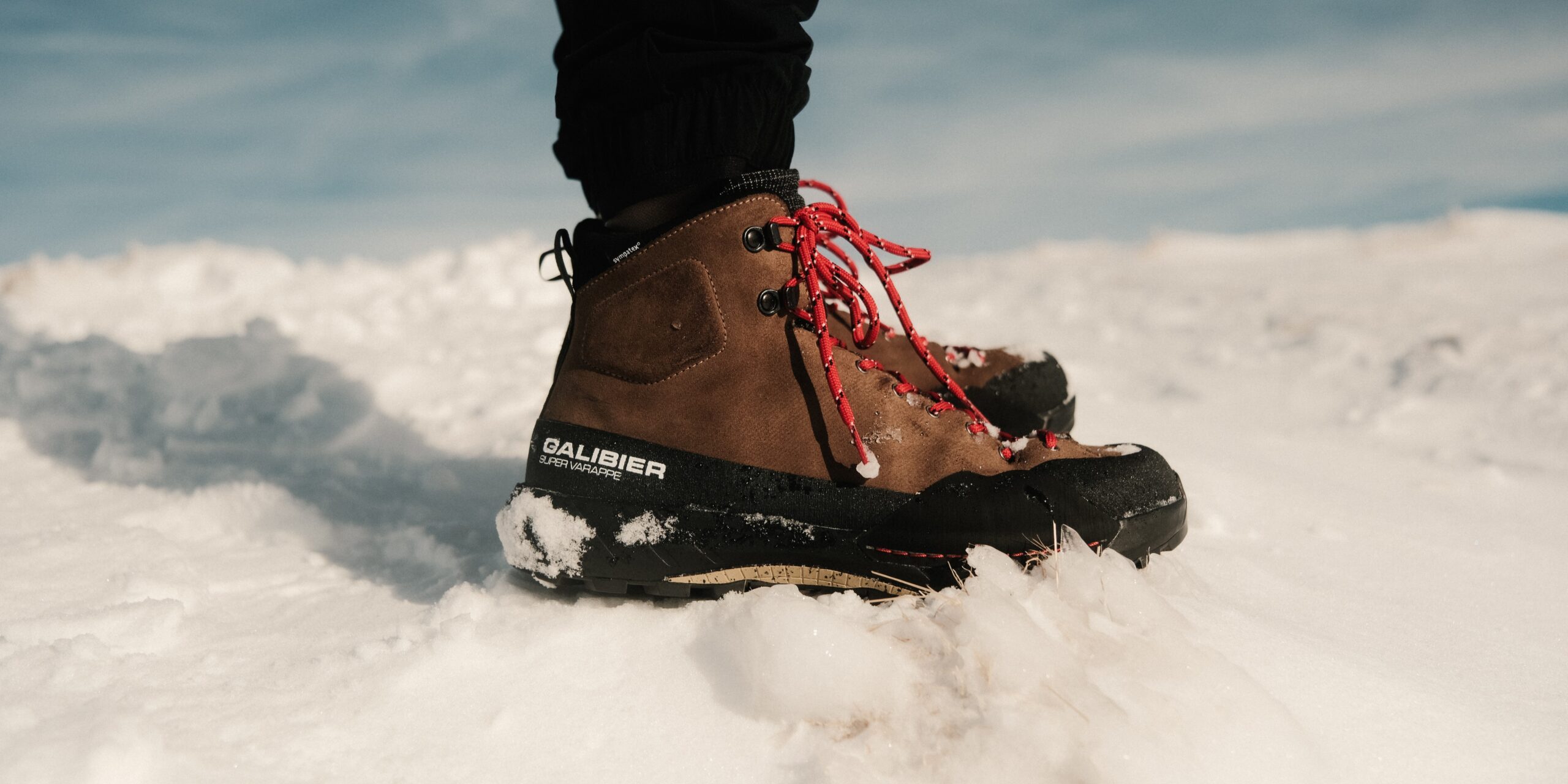
Gore-tex footwear is often the obvious choice for outdoor enthusiasts. Textile innovation has profoundly changed mountain equipment over the last few decades. For the mountaineers and hikers of yesteryear, protecting themselves from the rain often meant wearing heavy, rigid and totally hermetic materials. While this equipment effectively blocked external water, it also trapped perspiration. The inside of the shoe or garment thus became a veritable oven.
To design our mountain boots, we study the science of materials. Our membranes keep feet dry in the rain, and also wick away body moisture. As a long-standing manufacturer, Galibier invites you to decipher how these waterproof and breathable membranes work. Discover the heritage of the gore tex membrane.
What are Gore-Tex boots?
The story of the world’s most famous waterproof/breathable membrane began in the late 1950s in the USA. At the time, Bill Gore was employed by Dupont, a pioneering company in plastics chemistry and the discoverer of Teflon. Bill Gore saw immense and largely underestimated potential in a specific polymer: polytetrafluoroethylene, more commonly known as PTFE. Convinced that this material held unprecedented potential for apparel and industry, he decided to set up his own company.
However, the early stages were complex, requiring many years of research. It wasn’t until the late 1960s that a real scientific breakthrough was achieved. His son, Bob Gore, modified the structure of Teflon. He stretched it abruptly, creating expanded PTFE.
This new material is microporous and boasts a fascinating physical property. This material will redefine the standards of outdoor equipment, by blocking water droplets from the outside. However, it allows water vapor generated by body heat to escape.
This membrane’s feat lies in its microscopic architecture. Imagine an extremely thin layer inserted between the inner lining and the outer material of your footwear. The principle of the membrane integrated into Gore-Tex hiking boots is based on this precise textile architecture.

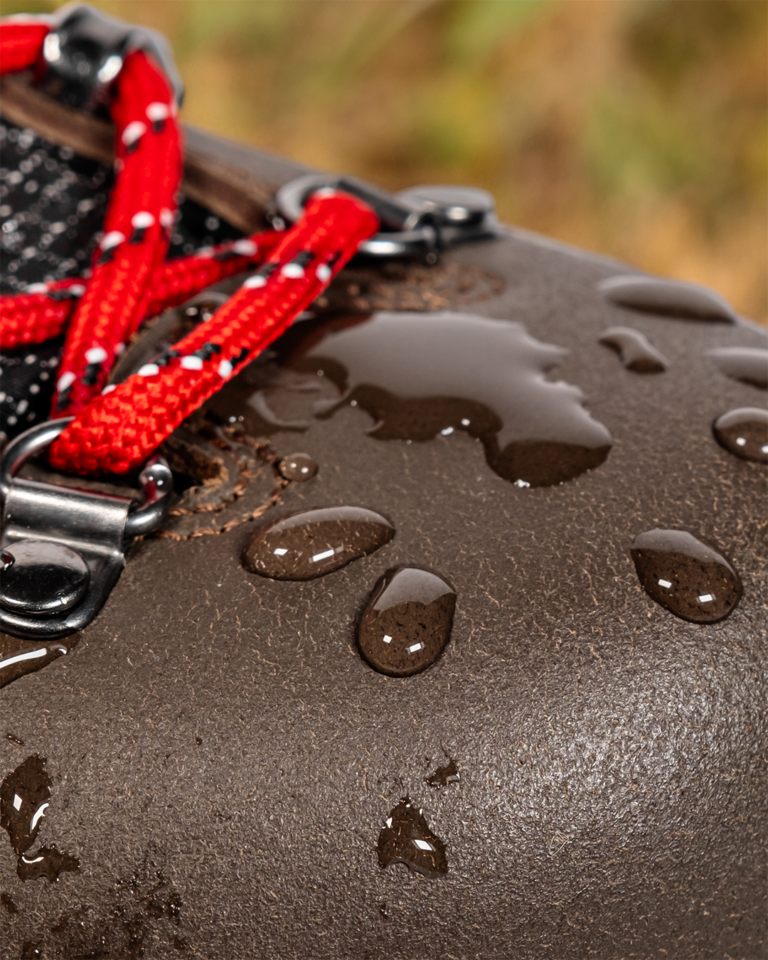
The secret lies in a simple question of scale: each of these pores is around 20,000 times smaller than a drop of water, making it physically impossible for rain or snow to penetrate. At the same time, these same pores are 700 times larger than a molecule of water vapour. Perspiration, which takes the form of gas during exertion, can therefore evacuate freely through the material.
The PTFE controversy and the evolution of Gore-Tex membranes
PTFE on Gore-Tex footwear has greatly improved protection against the elements. Today, its use raises environmental issues, with the chemistry of perfluorinated compounds coming in for criticism. The PTFE in classic Gore-Tex membranes is one of these, as these chemicals are persistent.
They are sometimes called “eternal pollutants” or PFAS. These pollutants degrade very slowly and can therefore accumulate in ecosystems.
Faced with these challenges, the outdoor industry is having to reinvent itself. Many manufacturers of waterproof textile membranes are now looking for alternatives capable of offering the same level of protection against the elements, without resorting to these persistent chemical compounds.
Internal membrane vs. water-repellent treatment (DWR): what’s the difference?
A common confusion persists among many hikers regarding the waterproofness of their footwear. It’s vital to distinguish between the internal membrane (the physical barrier) and a simple water-repellent treatment applied to the surface.
Water-repellent treatment, often abbreviated DWR (Durable Water Repellent), is a chemical coating applied to the leather or outer fabric of a shoe. Its role is to increase the surface tension of the material so that water beads up and slides off the fabric instead of seeping in. However, this surface treatment is temporary. With repeated rubbing against rocks, trail dust and time, DWR inevitably wears off.
In contrast, an internal membrane integrated into the heart of the walking shoe provides continuous waterproof and breathable protection. It does not fade with abrasion. However, wear and tear of the external water-repellent treatment has a direct impact on the performance of your equipment.

If the DWR disappears, the outer leather or textile can become waterlogged in the rain. Water won’t penetrate the membrane to reach your foot, but this moisture-saturated outer layer will create a “sponge effect”. This wall of water completely blocks the shoe’s breathability, trapping your perspiration inside and creating heavy condensation.
It’s this internal moisture that often gives a feeling of cold and the false impression that the shoe is leaking. That’s why regular maintenance of the outer water-repellent layer is essential, even on shoes fitted with a membrane.
Why choose Gore-Tex hiking boots?
The mountains are an environment where the weather can be particularly unstable. Choosing hiking boots in Gore Tex or with an equivalent membrane meets a fundamental need: protecting your feet. Moisture is a hiker’s main enemy. A wet foot rapidly cools down, the skin softens and repeated rubbing against the sock and lining inevitably leads to blisters.
Opting for waterproof protection guarantees constant comfort on wet terrain. Like when crossing streams, in mud or in showers. Breathability is just as important for intense effort and long distances.
Without this breathability, perspiration would remain trapped, creating a clammy sensation just as conducive to overheating as the water outside. Whether you opt for a high upper for maximum support or a low upper. Our dual promise of insulation and wicking is the cornerstone of comfortable walking in all seasons.
Sympatex: our eco-friendly alternative to Gore-Tex membranes
At Galibier, we’ve been mountain shoemakers for a long time. Our heritage drives us to seek the perfect balance between technical innovation and respect for our playground. To guarantee the highest levels of waterproofing and breathability on our models, while limiting our environmental impact. We have made a militant choice in favor of Sympatex technology.
Unlike historic Gore-Tex, which uses a microporous structure, the Sympatex membrane used on our Super Rando Mid and Super Varappe Mid is a monolithic membrane. It is totally smooth and pore-free.
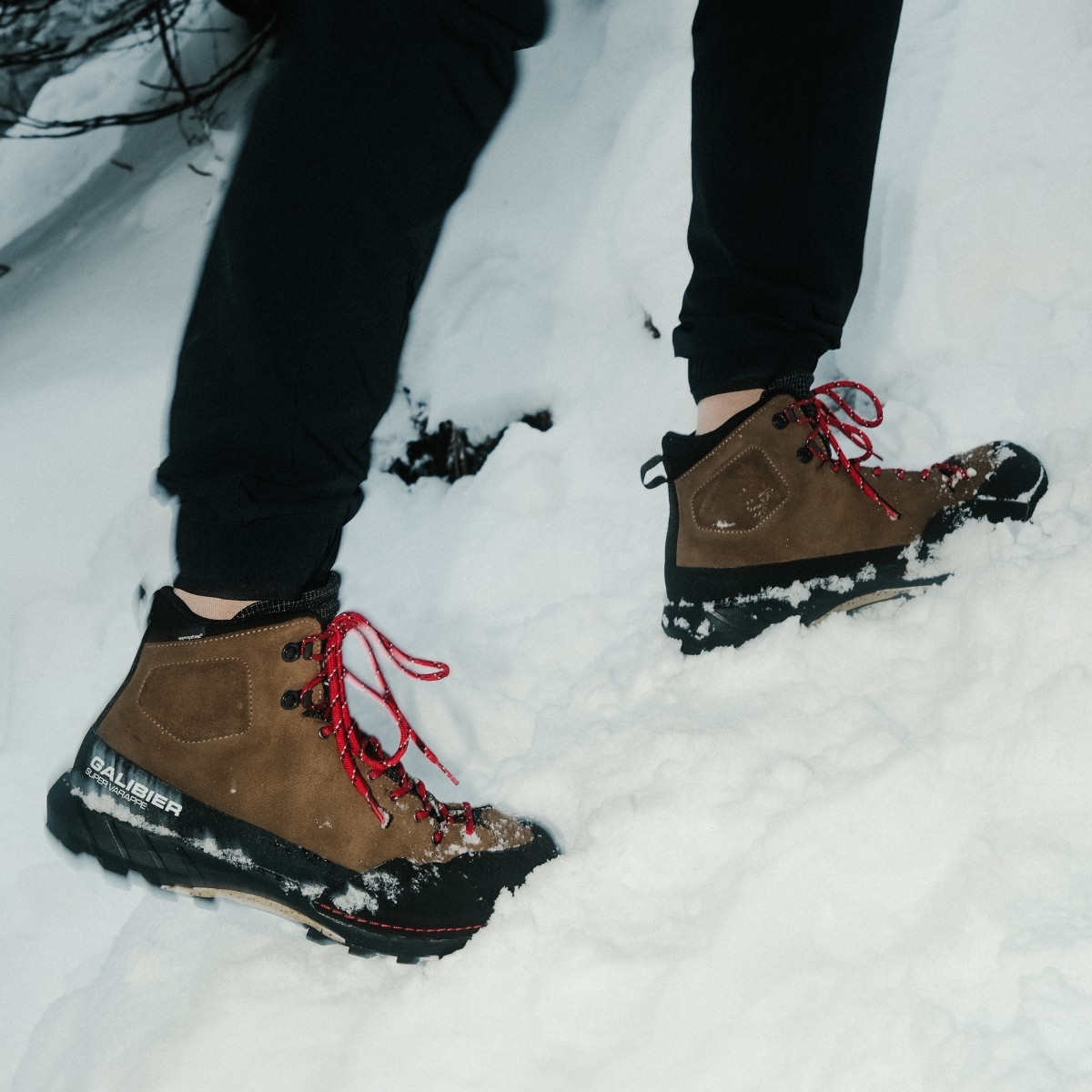
Its operation is based on a physico-chemical diffusion principle. The membrane is composed of hydrophilic molecular chains. These molecules literally attract the moisture generated by your effort, absorb it, then evacuate it to the outside of the shoe under the effect of temperature and pressure differences.
Gore-Tex shoe care

1 – Drying
Leave to dry naturally in an airy room, away from heat sources (radiator, fireplace, sun) to prevent the leather from hardening or warping.

2 – Brushing and cleaning
Brush and clean gently to remove dust, mud and dirt, using a polishing brush or foam cleaner if necessary, but never machine wash shoes.

3 – Nourishing the leather
Apply a thin layer of natural wax to keep leather supple, prevent cracking and revive its color.

4 – Waterproofing
Spray a waterproofing agent all over the shoe, paying particular attention to the seams, to limit water penetration and extend the life of the leather.
FAQ – Gore-Tex footwear
GALIBIER

The difference between a microporous membrane and a monolithic membrane is crucial when purchasing a gore tex shoe (or equivalent).The historic technology, often associated with gore tex men’s hiking shoes or gore tex women’s hiking boots, uses a microporous structure .In contrast, the Sympatex membrane (used, for example, on the Super Rando Mid and Super Varappe Mid) is a monolithic membrane . It has no pores, but absorbs moisture and transfers it to the outside via a physical-chemical process. This technological choice is often considered superior in the long term.
The durability of a membrane is highly dependent on its basic technology and the care you give it. Conventional microporous models, such as a low men’s gore-tex hiking boot that ‘s heavily exposed to mud, or lightweight women’s gore-tex hiking boots used on dusty trails, can see their breathability drop over time if dirt or salt crystals clog the pores. The Sympatex technology we use works differently. Being totally pore-free, it is not subject to clogging by dirt, or alteration by detergent or sebum residues. So its waterproof performance remains constant, offering the reliability sought by those targeting high-tech men’s gore tex hiking boots or women’s gore tex shoes. Of course, regular cleaning with a brush remains essential.
This is a recurring question among walkers equipped with gore tex hiking boots. Technically, the inner membrane is intrinsically and durably waterproof, so you don’t need to waterproof it.However, whether you have women’s gore tex hiking boots or men’s gore tex shoes, it’s absolutely crucial to maintain the water repellency of the outer material. If you don’t, the leather will become waterlogged, blocking the evacuation of perspiration and causing heavy internal condensation. After cleaning with clear water, the application of a suitable maintenance wax or our Galibier waterproofing spray will revive the water repellency of the outer shell, allowing the shoe to retain all its breathability.