
Gore-Tex hiking boots: comfort and waterproofing
Article published on 15 December 2025
When you look for a Gore-Tex hiking boot, you’re aiming for a simple promise: to stay dry and move forward serenely in the rain or on soggy terrain. But the truth is, Gore-Tex is not a miracle solution. A shoe’s waterproofness also depends on its leather, its assembly, its upper and its maintenance… all essential parameters for keeping your feet protected, even when the weather takes a turn for the worse.
Right from the start, let’s set the scene: the Gore-Tex membrane is the historical benchmark for outdoor clothing. At Galibier, we’ve chosen a different path, with Sympatex membrane.
We share the same requirement: to be able to cross a waterlogged meadow or tackle a wet climb without ever ending up with soaked feet. That’s why we’ve chosen to combine full-grain leather with Sympatex membrane, a waterproof-breathable technology designed for longevity. Because a real hiking boot is much more than its label.
The brand with the red lace: a detail, a signature, a heritage

Did you know? The mountain is a story of gestures. In our workshops, we have welcomed guides, alpinists, hikers and passionate outdoor enthusiasts who leave early and return late. They remind us that a good pair of boots is not a marketing promise, but a companion that can be repaired, maintained, and shaped to the foot over time.
This culture of durability guides our choices: leather uppers that age beautifully instead of being discarded, Norwegian welt construction and soles designed to be resoled, robust linings and Sympatex membranes. Our boots are made to be cared for, followed over the years, and sometimes brought back to the cobbler. The mountain rewards accuracy and longevity — and so do we.
Gore-Tex, Sympatex: choosing your hiking boots
The Gore-Tex membrane works with a microporous film inserted into the upper. Its pores are small enough to block water, but large enough to let steam from perspiration escape. It’s this principle that has made the reputation of Gore-Tex hiking boots and many other mountain boots: staying dry.
Sympatex, the membrane we use, takes a different approach. It’s non-microporous and hydrophilic: instead of relying on pores, it transfers moisture through a molecular mechanism. On your feet, the feeling is very similar: waterproof, breathable, windproof. And there’s an added bonus: because there are no pores, nothing can clog up, and performance remains stable over time.
Sympatex is also PTFE-free and 100% recyclable.
An important point for riders who want to reconcile technique and responsibility.
Is it absolutely necessary to choose a Gore-Tex hiking boot over a Sympatex-equipped pair? Not necessarily. In use, what really makes the difference is thecomplete assembly: quality of the upper (leather or textile), precision of the assembly, rigidity of the midsole, design of the sole, fit of the boot.


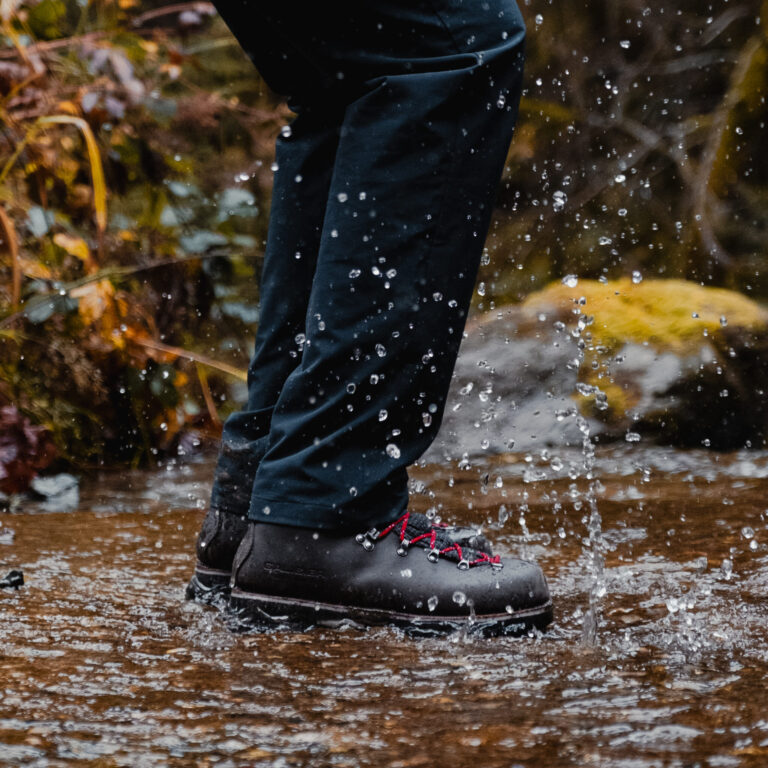
Before looking at the membrane label, ask yourself what kind of weather, terrain and pack you walk in most often. This is the context that should guide your choice of walking shoes.
Low or mid upper: which shoe is right for you?
Next comes the choice of stem.

The low upper seduces with its freedom of movement and lightness. On well-marked trails, active walks, city-trips and day hikes, it offers a natural stride pattern and a feeling of agility. However, a little less lateral protection on scree slopes, steep inclines or with a heavy pack.
The mid upper provides additional ankle support. As soon as the terrain becomes more chaotic, the days become longer or the weather deteriorates, this support changes the game. On descents, the mid shaft stabilizes, and on slopes, it reassures you over the long haul and saves your weight. The weight climbs slightly, but comfort at the end of the day benefits.

The more you value safety, the more you’ll opt for a high upper. The closer you are to fast hiking, the more the low shaft becomes your preferred choice.
Our waterproof Galibier boots: the Sympatex alternative
At Galibier, we don’t offer Gore-Tex footwear. We’ve made a different choice: to combine the Sympatex membrane with full-grain leather, materials selected for their performance… and their longevity in the field.
If you’re a fast, all-day walker, we’d recommend the Super Rando Low model. Low-cut upper, flexibility for fast walking, low weight, good foot support. Sympatex membrane to keep feet dry in morning humidity or late-day showers.
For longer hikes, with a heavy pack and varied terrain, a Super Rando Mid model will be more suitable. You’ll benefit from more generous ankle support, as well as increased protection on rough terrain thanks to Sympatex protection.
Then it’s up to you to filter according to your terrain (forest trails, gravel, wet alpine pastures). Your seasons (changeable spring, summer at altitude, wet autumn) and how often you hike. The more you hike, the more worthwhile it is to invest in a hiking boot designed to last several seasons. That way, you can accept a few extra grams on your feet.
Vibram and waterproof membrane: a demanding duo

Many walkers are looking to combine a waterproof membrane with a Vibram sole, regardless of whether they’re in the men’s or women’s category. The idea is a good one: combine a waterproof membrane with a Vibram outsole, known for its grippy rubber and effective lugs. This duo is a very good starting point, but it’s not an end in itself.
What counts is the way the whole is thought out: midsole rigidity, lateral stability, sole thickness, cushioning, contact with the ground. Here again, overall coherence takes precedence over the addition of technical logos.
Maintenance, comfort and longevity: details that count
Adopt the right tips for maintaining your waterproof hiking boots.

1 – Drying
Leave to dry naturally in an airy room, away from heat sources (radiator, fireplace, sun) to prevent the leather from hardening or warping.

2 – Brushing and cleaning
Brush and clean gently to remove dust, mud and dirt, using a polishing brush or foaming cleanser if necessary, but never machine wash shoes.

3 – Nourishing the leather
Apply a thin layer of natural wax to keep leather supple, prevent cracking and revive its color.

4 – Waterproofing
Spray a waterproofing agent all over the shoe, paying particular attention to the seams, to limit water penetration and extend the life of the leather.
FAQ about waterproof hiking boots
GALIBIER

A Gore-Tex hiking boot incorporates a waterproof, breathable membrane between the upper and the lining, which blocks water while allowing perspiration to escape.
A classic boot relies mainly on water-repellent treatments, which are less durable in the rain.
At Galibier, we use Sympatex, a pore-free membrane that is 100% waterproof, windproof and recyclable, for equivalent performance with a reduced environmental footprint.
Technically, both guarantee total waterproofing and excellent breathability. Gore-Tex uses a microporous PTFE membrane , the historic leader in the outdoor market.Sympatex, on the other hand, operates without pores: water vapour is absorbed and transferred to the outside by a hydrophilic process . It is 100% recyclable, PTFE-free, and retains its performance longer because the pores cannot become clogged. At Galibier, we chose Sympatex to combine high technical standards with environmental responsibility.
Searches for “Gore-Tex hiking shoes for men“ or “Gore-Texhiking shoes for women“ or“Gore-Tex hiking shoes forVibrammen” reflect a morphological reality:women’s feet tend to have a thinner heel, lower instep and wider forefoot; men’s feet tend to have a greater overall volume and higher instep. These differences have a direct influence on comfort, support and stability when walking.


