

Mountain footwear is not a detail. It’s the essential element that can make the difference between a well-mastered outing and a day where everything becomes tedious. A real mountain boots can handle rough terrain. It can handle rocks, mud, roots, slopes, long descents and difficult weather.
Today, the range is vast. From ultra-light, trail-inspired models to boots designed for expeditions, it’s easy to get lost. Even for experts, the terrain imposes its own rules: abrasion, gravity, humidity, cold.
This guide has a simple objective. It helps you choose the right pair of shoes. Whether you’re looking for men’s mountain boots or women’s mountain boots. We’ll give you the facts about each type of shoe.
At Galibier, a mountain boot is not just another “outdoor product”. It’s a piece of equipment designed for action and intended to reflect experiences. Immediate appeal is not enough. Reliability and stability in case of fatigue count. Choose a shoe that can be repaired rather than replaced.
Mountain footwear, from yesterday to today
Understanding what you’re wearing today also means looking at the history of a piece of equipment shaped by necessity. Mountain footwear was born out of mountaineering and hiking. They are a technical response to demanding terrain, not a fashion statement.
Did you know? Cousu Norvégien’s marine origins

Did you know? Galibier’s famous visible stitching isn’t actually alpine in origin. It was born in the North Sea.
This double-stitching technique was originally used for Scandinavian fishermen’s boots. Its purpose? To create an impenetrable barrier against salt water and freezing cold on ship decks.
The genius of the Richard-Pontvert family was adapting this maritime waterproofing to alpine verticality. When you wear Galibiers in the snow, you’re actually benefiting from technology designed to withstand the waves.
The legacy of verticality
In the age of alpine exploration, figures like Lionel Terray and René Desmaison favored survival over comfort. Their equipment was rudimentary: heavy leather brodequins, often studded, heavily greased to withstand the snow. Galibier forged its legend in this vital requirement, notably with the SuperGuide model.
Back then, the quality of mountain boot brands was judged by their resistance to extreme conditions, not by their design. This technical heritage is our DNA: protection takes precedence over lightness.
The return of vintage mountain footwear
There is currently a strong craze for vintage mountain footwear. But beware of pretence. Retro style is a fashion, traditional construction is a technique.
If many mountain sports enthusiasts are returning to leather mountain boots today, it’s not out of nostalgia. It’s a rational choice for reliability. Unlike modern synthetic materials, which can tear or whose glues age badly (hydrolysis phenomenon).
A full-grain leather upper offers superior mechanical resistance to scree. Wearing a Galibier today means rejecting programmed obsolescence in favor of proven technicality.
At Galibier, our footwear is designed for the mountains, combining the heritage of past challenges with today’s innovations.
What are mountain boots used for?
A mountain boot is more than just a rigid walking shoe. Designed for rugged terrain: scree, technical trails, mud, névés, roots and slopes. Ideal for long descents. Unlike sneakers or city shoes, mountain boots offer protection and control.
Its role is concrete: to protect the foot from impact, stabilize support when the ground is uneven, offer reliable grip, and reduce the physical wear and tear associated with the repetition of shocks and imbalances. This logic becomes even more important when fatigue sets in: the best walking technique cannot compensate for a shoe that lets the foot float.

Mountain walking shoes or high-altitude shoes: two needs, two rationales
Mountain hiking boots are often a source of confusion. However, it’s essential to distinguish between the specific needs of a simple day outing and those of progressing through alpine terrain.
Mountain walking shoes are designed to offer a compromise between foot support, walking comfort and stability, without becoming overly rigid and keeping feet warm. They can come in low or mid-cut uppers, depending on terrain and load.
High-mountain boots, on the other hand, are designed for more demanding conditions: cold, snow, more technical terrain, and sometimes the need for crampon compatibility, depending on the type of activity. Stiffness becomes a safety tool, not an option. A mountain snow boot may suffice for some winter outings, but as soon as the commitment increases (cold conditions, technical terrain, long exposure), the “high mountain” category takes on its full meaning.
Norwegian sewing: a signature of longevity
Many of today’s outdoor shoes use a glued assembly: it’s lightweight, quick to produce, and effective for certain uses. The downside is that repairs are often more limited.
Norwegian stitching mechanically joins the upper and sole. The welt is visible on the outside. Appreciated in the mountains, it strengthens the shoe (solidity, waterproofing). As a result, the shoe can be maintained and resoled. A reliable mountain boot is a partner, not a consumable.


Women’s mountain footwear vs. men’s: what are the differences?
Yes, there are differences, and they are primarily morphological. Instep volumes, forefoot width, heel thinness and typical friction zones vary. A well-designed women’s mountain shoe can better lock the heel and limit certain hot spots. A men’s mountain shoe may offer more volume, depending on the range.
But the rule never changes: the best model is the one that really fits. In the mountains, a poor fit quickly pays off, especially on descents. The right approach is therefore to start from your morphology and sensations, not from a label.
How to choose your mountain boots
Rather than looking for "the best shoe", start by defining your terrain and frequency of use. Choosing a mountaineering boot is first and foremost a matter of being honest with your own practice. There's no point in buying a model designed for mountaineering if you're mainly doing day hikes, and conversely, a simple walking boot will quickly show its limits if you're doing long, uneven outings, or walking in winter conditions.

Type of terrain and frequency of use
On easy, regular itineraries, a softer mountain hiking shoe, sometimes with a low shaft, may suffice. They offer a natural, dynamic walking experience, and are a coherent option if you also practice fast hiking on controlled terrain.
As soon as you increase the frequency, duration, load or technicality of the terrain, you’ll benefit from switching to a more structured model: greater stability, better protection, a more reassuring sole on slopes and downhill. This is where the shoe becomes “silent”: you think less about it, because it does its job.
If you’re into mountaineering, highly technical terrain or harsh winter conditions, you’re entering the world of high-altitude footwear. In this context, rigidity, insulation and the ability to maintain precision become priorities. A winter mountain boot must above all protect against the cold coming from the ground and humidity, while remaining stable on changing terrain.
The stem: height, support, freedom of movement
Upper height is not a question of looks, but of use. Low uppers offer greater freedom of movement and a more agile stride. They’re ideal for fast, summery outings, or for those who like a natural stride.
A mid or high shaft provides extra support and protection. On unstable terrain, on slopes, with a pack, or when fatigue sets in, this support becomes a real safety factor. It’s not a question of “blocking” the ankle, but of stabilizing the foot and limiting the micro imbalances that end up costing you dearly over the course of a long day.
The sole: grip is not negotiable
Technical soles aren’t just about grip. Our two-component Vibram Durastep and SpringLug system is designed to optimize your effort. The internal SpringLug foam (polyurethane) absorbs shock not to collapse, but to distribute pressure intelligently, limiting muscle fatigue on long days of walking and repeated descents.
The “slipper effect” you feel is the result of this technology which, despite the shoe’s rigidity, offers a subtle return of energy. Coupled with Durastep rubber, which guarantees maximum grip on wet or rocky ground, you get a block sole that secures the foot and works for you on long days of walking and repeated descents.
Stiffness, cushioning, weight: finding the right balance
We often hear “I want a soft shoe”. On flat ground, it’s pleasant. In the mountains, rigidity often becomes an ally: it acts as a stable platform in scree, on slopes or on small rocky supports. It also limits exhaustion due to repeated micro-torsions.
Weight counts, of course. But a shoe that’s too light, offers poor protection or wears out quickly, is rarely a good calculation. Conversely, too much rigidity on simple terrain can be detrimental to comfort. The right choice is one that remains stable without constraining you, and that corresponds to your actual terrain, not an ideal scenario.
Materials and technologies: what makes the difference

When it comes to mountain boots, the choice of materials is never insignificant. It determines the pair's durability, everyday comfort and behavior on rough terrain.
Sympatex: guaranteed waterproofing
Gore-Tex is a well-known reference, but it’s not the only solution. At Galibier, we use Sympatex, a waterproof/breathable membrane designed to block water while allowing vapor to escape.
Nevertheless, if you’re looking for waterproof hiking boots, keep one simple idea in mind: waterproofness isn’t just a material, it’s a system (construction, maintenance, drying, and sometimes gaiters in very wet conditions). The choice of mountain boots is crucial to safety and comfort, especially in the face of seasonal variations.
While summer allows for lighter options, winter and extreme conditions call for greater protection. Thick leather (2.4mm at Galibier) insulates better than synthetic mesh. Adequate volume is essential to wear merino wool-based hiking socks , without compression, to prevent freezing.
Leather vs. synthetic: an ecological and economical choice
Full-grain leather remains the benchmark for reliable, repairable mountain boots. Leather develops a patina, is made on the foot, resists abrasion well and retains an appreciable structure when the terrain becomes dangerous. Properly cared for, it can withstand years of use. In return, it requires maintenance.
Synthetic materials often save weight and dry faster. They can be coherent for very dynamic, summery practices, or if the priority is lightness. However, when used intensively and on abrasive surfaces, they wear out more quickly.
At Galibier, the choice of full-grain leather is both ecological and economical. Unlike synthetic materials, which are often destined for a short life cycle. This leather is chosen for its ability to be repaired and to age. It can therefore be resoled. We are committed to supplying reliable, responsible equipment. This helps limit environmental impact by avoiding premature renewal.
Galibier: the demands of Alpine tradition
At Galibier, the mountain is not a catalog décor. It’s a terrain of use, a laboratory, a starting point. The brand is part of a culture of technicality: a shoe must protect, hold, stabilize over time, and remain maintainable.
For decades, our mountain boots have equipped guides, hikers, mountaineers and lovers of the great outdoors. This link with alpine tradition is reflected in every detail
Our history
Our expertise
DiscoverOur shoes are designed with a responsible approach: they are resoleable and have a sobriety reminiscent of vintage mountain footwear, while incorporating today’s requirements in terms of grip and comfort.
Our reference models
Talking about criteria is useful. Linking them to models is what makes the choice concrete. Here are two families that illustrate the Galibier approach. Each model has its own particular terrain, but all share the same DNA: protection, longevity and reliability.
Super Guide: the icon for demanding hikers
A true icon of the Galibier brand, the Super Guide is the ultimate mountain boot for demanding hikers.
If the SuperGuide is considered the “Land Rover” of mountain boots, it’s not by chance. In the 60’s and 70’s, it became the equipment of choice for the mountaineering elite and the French Polar Expeditions.

The reason? Before the advent of plastic shells, it was the only leather boot to offer sufficient rigidity for vertical cramponing, while remaining reliable in extreme cold.
The ultimate proof of this reliability? Even today, it’s not uncommon to come across mountain enthusiasts wearing a pair of shoes they bought new 40 or 50 years ago. Maintained and resoled, these shoes continue to climb the peaks, living proof that well-maintained leather can last.
Super Rando Mid and Low: the agile mountain version
The Super Rando Mid and Low meet today’s demand for faster, lighter and safer walking.

The Super Rando Mid (mid-high shaft) provides versatile support for regular hiking, long days and heavier packs.
The aim is to preserve the Galibier DNA: guaranteeing reliability, utility and consistency for a mountain boot, while favoring a more “dynamic” approach. This is in line with the expectations of fast hikers: performance without compromising on sturdiness.
The Super Rando Low (low shaft) is designed for more dynamic walking, suitable for fast hikers and those who prefer freedom of movement on controlled terrain.

Super Varappe Mid and Low: the multi-activity and approach shoe
Whether you are a rock purist, a fast hiker, or a fan of long technical traverses, the Super Varappe range is available to specifically meet your needs.
Available in Mid and Low uppers, the Super Varappe range shares a common aesthetic and construction, designed for all practices and all profiles of mountaineers. At Galibier, the design of our models is always focused on use. We create products designed for the mountains, whatever the weather.
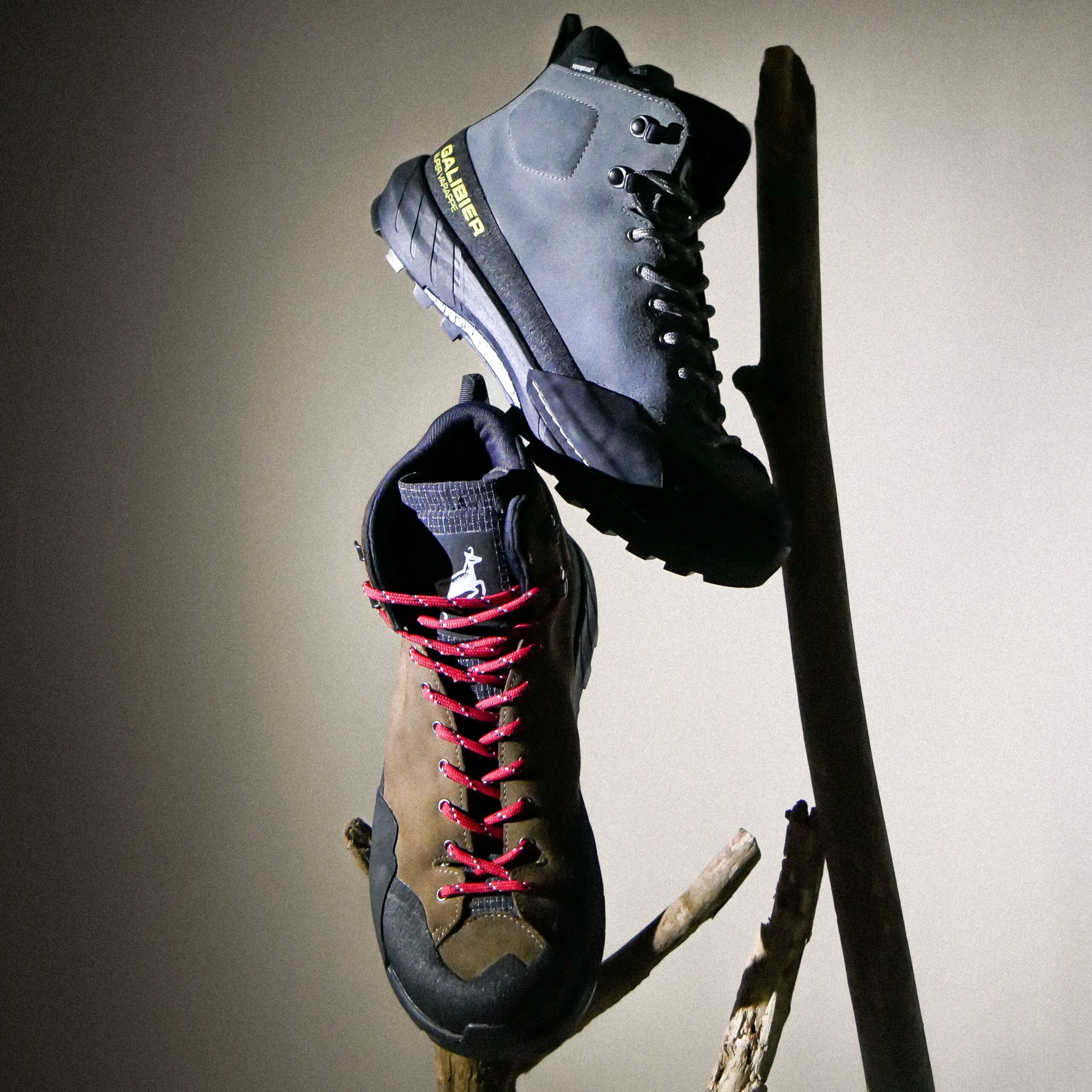
Super Varappe Mid
The approach shoe for your treks. The Super Varappe Mid offers total waterproofing (100% recyclable, PFAS-free Sympatex membrane) and high breathability. Its mid-cut upper ensures unwavering ankle support on uneven terrain.
Super Varappe Low
The ultimate tool for freedom of movement, the Super Varappe Low is a light (765 g) and ultra-competitive shoe. Featuring Perwanger leather and a Dyneema tongue, it is ideal for approach and via ferrata.
If you want to go further in preparing your mountain outings, you can also consult the recommendations of a specialized organization such as MonGR. Their guide to the equipment you need to take on tour is an excellent basis for preparing your bag before long hikes.
Taking care of your ideal mountain boots
Adopt the right tips to maintain your ideal mountain boots.

1 – Drying
Leave to dry naturally in an airy room, away from heat sources (radiator, fireplace, sun) to prevent the leather from hardening or deforming.

2 – Brushing and cleaning
Brush and clean gently to remove dust, mud and dirt, using a polishing brush or foam cleaner if necessary, but never machine wash shoes.

3 – Nourishing the leather
Apply a thin layer of natural wax to keep leather supple, prevent cracking and revive its color.

4 – Waterproofing
Spray a waterproofing agent all over the shoe, paying particular attention to the seams, to limit water penetration and extend the life of the leather.
FAQ about the ideal mountain boot
GALIBIER

A Gore-Tex hiking boot incorporates a waterproof, breathable membrane between the upper and the lining, which blocks water while allowing perspiration to escape.
A classic boot relies mainly on water-repellent treatments, which are less durable in the rain.
Leather remains the benchmark for a durable mountain boot: stable fit, good protection on rough terrain, resealability, good patina over time. Ideal for those who hike regularly, carry a pack or chain seasons with the same pair. Synthetic models are often lighter and dry faster. They are well-suited to dynamic practices (fast hiking, short summer hikes) or to those who prefer lightness above all else. At Galibier, we stand by our choice of leather: for us, it’s the best compromise between comfort, safety and longevity for a mountain hiking boot.
A mountain boot is not only replaced when the leather is marked. You can also replace a boot when the grip is poor (smoothed crampons), when the cushioning no longer does the job, or when the upper no longer holds the foot properly. If the leather upper is sound, Galibier can resole your boots. It’s more economical and responsible than a new purchase. If the structure is tired, buy a new mountain walking boot. This guarantees comfort and safety for your next hike.
Yes, as long as you respect its DNA. In fact, low-top shoes are stiffer and more protective than sneakers. They can be worn every day if you like this style, particularly for a vintage feel, as with the “Low” model, which is on the rise and has been adopted by many UK lifestyle influencers as a wardrobe essential. Just bear in mind that technical soles wear out faster on asphalt than on trails. For very urban use, alternating with another pair is often a good idea.


